
How to define social innovation competence? Learning Cafe workshop organised for educational experts around the project partner countries.
Authors
Anne-Maria Korhonen
Satu Niittylahti
Häme University of Applied Sciences, Finland
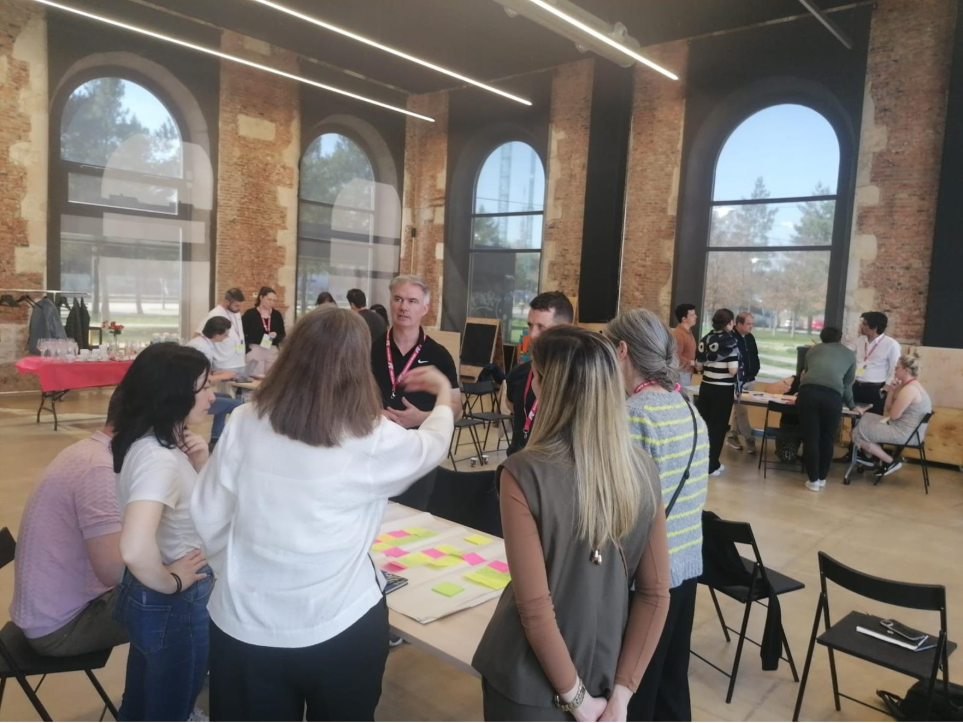
We have started the new project, European Social Innovation & Democratic Education (EU-SIDE), in April 2025, with the learning café workshop that took place at the University of Burgos, Spain. The workshop presented first the idea of social innovation through two cases that both became businesses. The first company has developed social innovations for renting apartments, while the second has created sanitary rooms in various locations to help people with disabilities with their personal hygiene needs. The cases opened the mind to consider what social innovation competence might be and how to educate students at various school levels to join the co-creation projects regarding social innovations. Second, the learning café itself focused on solving questions, such as What competencies and personal qualities does a social innovator possess; What approaches to social innovations do you see reflected in your work; What opportunities or quick wins do you see in your local or school environment where social innovation could make a positive difference; Where do you experience resistance or limitations when working on social innovation?
The learning café method, also known as a world café, is to discuss in small groups with each question. The questions are shared in small tables. There can be as many tables as required based on the number of questions or discussion topics. Originally, the questions and answers were written on a tablecloth, but nowadays they are written on paper, flip charts, or even digital tools. The groups remain the same, and they go round each table together. One person stays at each table for the entire workshop and writes down the comments as well as explains the earlier group’s comments to the next one. The first one or two rounds often take longer than the next ones. In our case, the discussion remained lively throughout, and the learning cafe method allowed us to share our experiences and look at the concept of social innovation from different perspectives. Generally, it is good to have one facilitator of the entire learning café process who can take care of time and answer questions if there are any misunderstandings of the process.
We don’t publish the answers of the learning café yet, because similar workshops are organised in the next few months in all partner countries. The questions are similar, but the orientation (cases of social innovation business) might vary from the one that the experts experienced. The aim is to collect as many viewpoints as possible to define as specifically as possible the social innovation competences. The definition is used in the next phase of the project when we start building the pedagogical framework for teaching these social innovation competences to students in all partner countries and at all school levels.
Image caption: Learning cafe in progress in the beautiful surroundings of the Science and Tecnology Station in Burgos