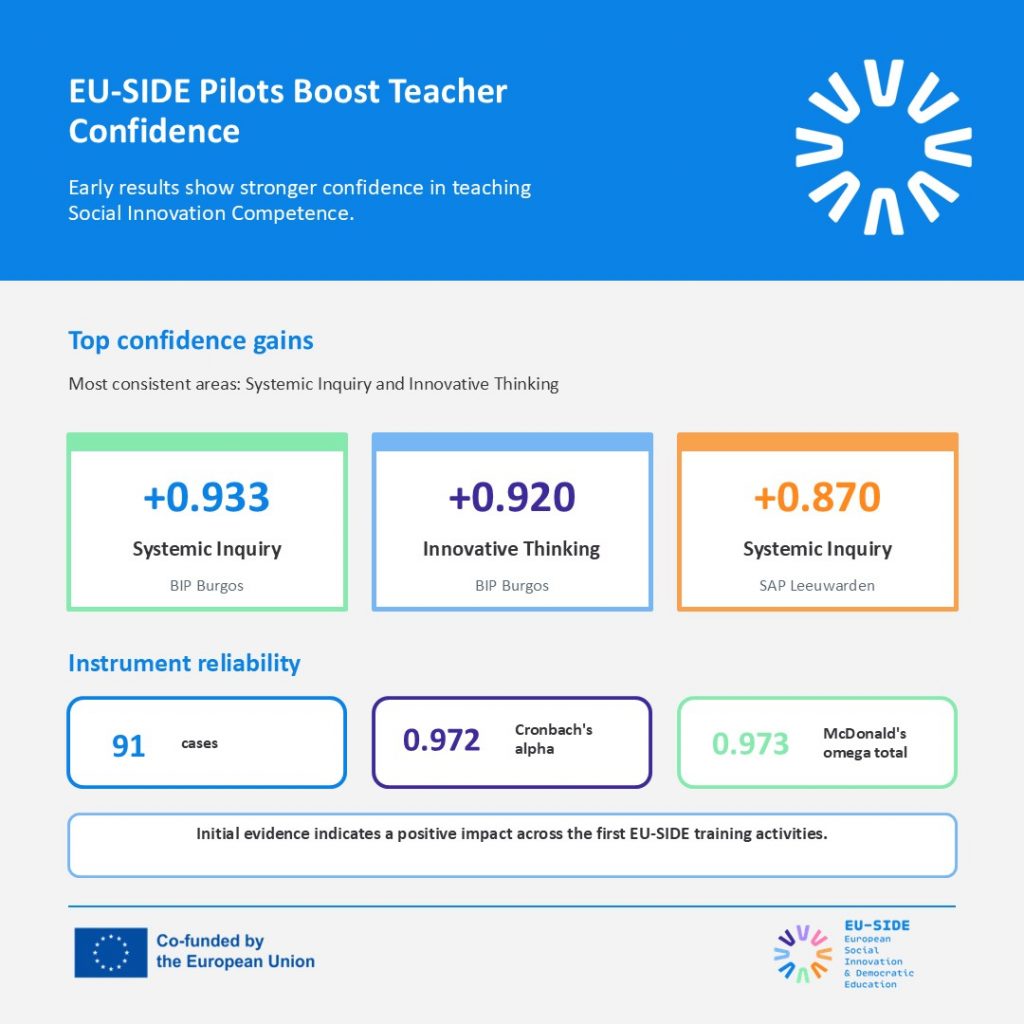

The first implementations of the EU-SIDE project training activities, including Blended Intensive Programmes (BIPs) and Short Advanced Programmes (SAPs) in Burgos, Leeuwarden, and Leiria, have yielded significant results regarding the self-efficacy test. Data collected through these pilots show a broader pattern of perceived improvement in participants’ readiness to teach Social Innovation Competence. Specifically, the dimensions of Systemic Inquiry and Innovative Thinking recorded the most consistent self-efficacy gains across the three formats. In the BIP Burgos pilot, for instance, participants demonstrated a mean gain of +0.933 in Systemic Inquiry and +0.920 in Innovative Thinking. Similarly, the SAP Leeuwarden implementation saw a +0.870 mean gain in Systemic Inquiry.
These results are supported by assessment instruments that demonstrated very high reliability across a dataset of 91 cases, with a Cronbach’s alpha of 0.972 and a McDonald’s omega total of 0.973. While the project acknowledges that self-efficacy is self-reported and serves as supportive evidence, these findings strengthen the conclusion that the first round of training activities had a positive impact. The strongest evidence of project impact appears where this increased confidence is also accompanied by improved scenario-based pedagogical judgement. A complete analytical report including recommendations for next training activities is now being prepared for quality review.